
If you want to grow your business online, understanding SEO and SEM marketing is essential. Every day, millions of people search for products, services, and answers on search engines like Google. Therefore, businesses that appear on the first page receive more traffic, leads, and sales.
Many beginners confuse SEO and SEM because both help websites gain visibility on search engines. However, they work differently and produce different results. SEO focuses on earning free organic traffic, while SEM combines paid advertising with search marketing to generate immediate visibility.
In this guide, you'll learn everything about SEO and SEM marketing, including how they work, their differences, advantages, disadvantages, and the best strategies to grow your website.
What Is SEO and SEM Marketing?
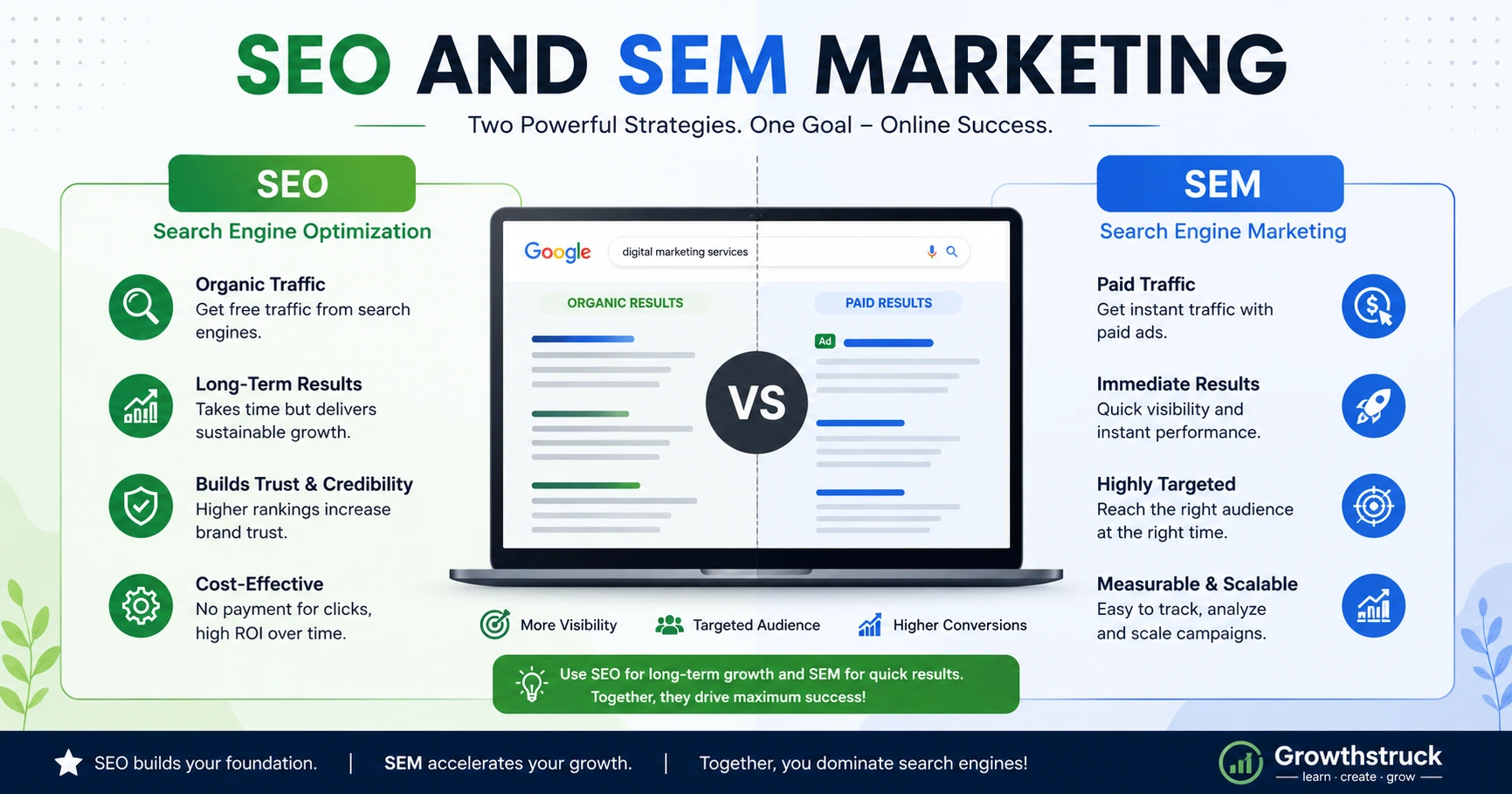
SEO and SEM marketing refer to two digital marketing strategies that help websites appear on search engine results pages.
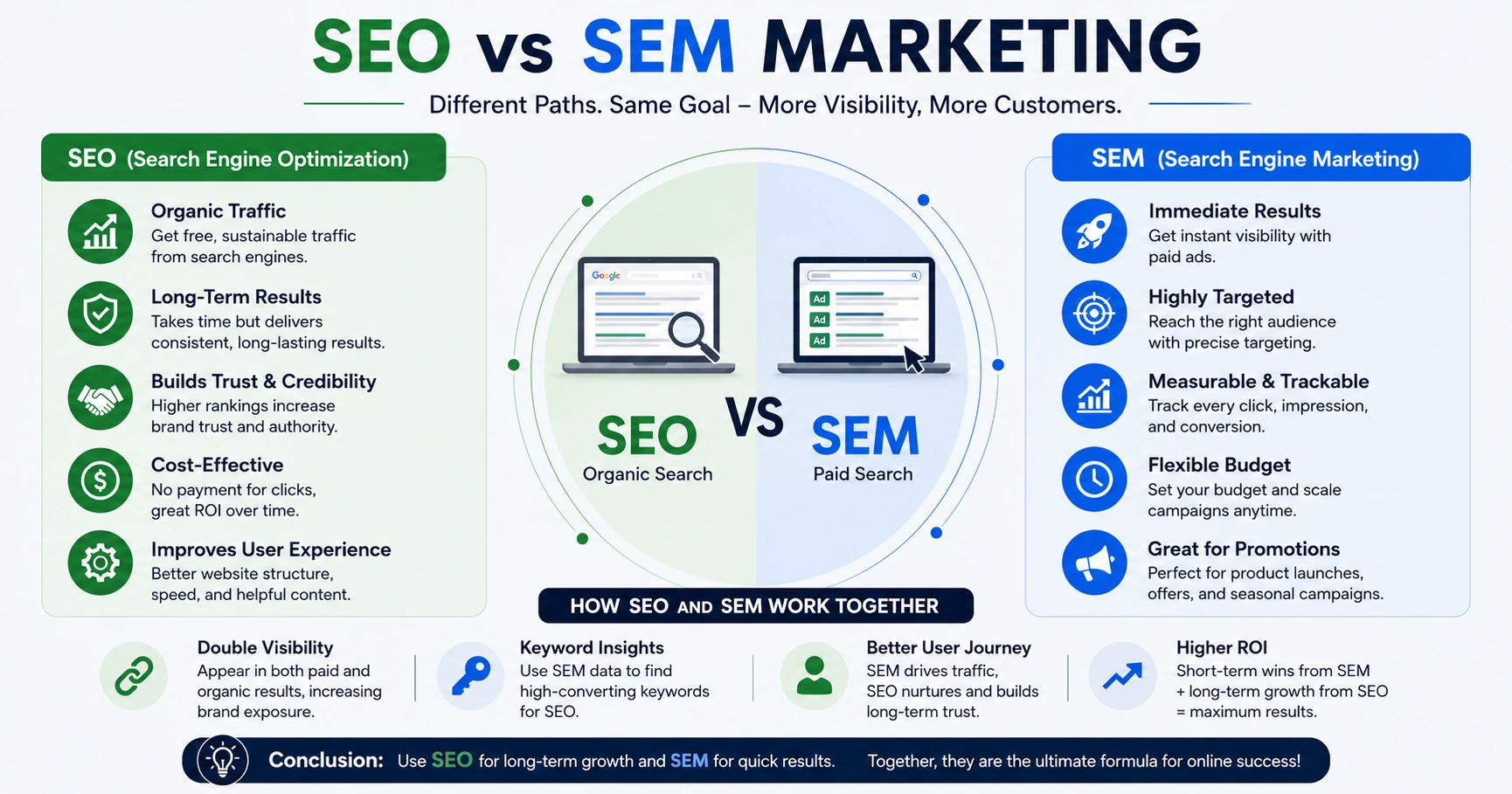
- SEO (Search Engine Optimization) improves your website's organic rankings without paying for clicks.
- SEM (Search Engine Marketing) uses paid advertisements alongside SEO to increase visibility and attract targeted visitors.
Although they share the same goal—bringing more visitors—they use different methods.
Businesses often combine both strategies because they complement each other. Consequently, they can achieve both short-term and long-term growth.
What Is Search Engine Optimization (SEO)?
Search Engine Optimization is the process of improving a website so search engines can understand and rank it higher.
Instead of paying for traffic, SEO focuses on creating valuable content, improving website performance, and earning backlinks.
Benefits of SEO
- Generates free organic traffic
- Builds long-term credibility
- Improves user experience
- Increases website authority
- Delivers sustainable results
- Offers a high return on investment
Furthermore, SEO helps businesses build trust because users generally prefer organic search results over advertisements.
Types of SEO
On-Page SEO
On-page SEO involves optimizing everything within your website.
This includes:
- Title tags
- Meta descriptions
- Headers
- Keywords
- Internal links
- Image optimization
- URL structure
- Content quality
For example, if your focus keyword is SEO and SEM marketing, you should naturally include it in your title, headings, introduction, and conclusion.
Off-Page SEO
Off-page SEO focuses on building your website's authority.
Common techniques include:
- Link building
- Guest blogging
- Social media sharing
- Digital PR
- Brand mentions
- Forum participation
As a result, search engines view your website as trustworthy and relevant.
Technical SEO
Technical SEO improves your website's backend performance.
It includes:
- Website speed
- Mobile responsiveness
- HTTPS security
- XML sitemap
- Robots.txt
- Structured data
- Core Web Vitals
Additionally, technical improvements help search engines crawl and index your pages more efficiently.
What Is Search Engine Marketing (SEM)?
Search Engine Marketing is a paid digital marketing strategy that displays advertisements on search engines.
Unlike SEO, SEM provides instant visibility because advertisers bid on keywords.
When users search for a keyword, paid ads often appear above the organic search results.
Therefore, SEM is an excellent choice for businesses that want immediate traffic.
How SEM Works
SEM follows a straightforward process.
- Research relevant keywords.
- Create compelling advertisements.
- Set your advertising budget.
- Bid on keywords.
- Launch your campaign.
- Monitor performance.
- Optimize continuously.
Because advertisers only pay when someone clicks their ad, this model is known as Pay-Per-Click (PPC) advertising.
SEO and SEM Marketing: Key Differences
Although SEO and SEM work toward the same objective, they differ in several ways.
| Feature | SEO | SEM |
| Cost | Organic | Paid |
| Results | Long-term | Immediate |
| Traffic | Free | Paid |
| ROI | High over time | Fast but ongoing cost |
| Sustainability | Excellent | Budget dependent |
| Credibility | High | Moderate |
| Maintenance | Continuous optimization | Continuous ad management |
Consequently, many successful businesses invest in both strategies instead of choosing only one.
Why SEO and SEM Marketing Work Better Together
Many marketers believe SEO and SEM compete with each other. However, they actually complement one another.
For example:
- SEO builds long-term authority.
- SEM generates quick leads.
- SEO reduces advertising costs over time.
- SEM provides keyword insights for SEO.
- SEO improves landing page quality.
- SEM helps promote new products instantly.
Therefore, combining SEO and SEM creates a balanced digital marketing strategy.
Benefits of SEO and SEM Marketing
Using both strategies offers several advantages.
Increased Visibility
Appearing in both paid and organic search results increases your brand's exposure.
As a result, users are more likely to click your website.
Better Brand Trust
Organic rankings build credibility, while paid ads improve visibility.
Together, they strengthen your online presence.
Higher Conversion Rates
SEO attracts users researching information.
SEM targets users ready to purchase.
Consequently, businesses experience better conversion rates.
Faster Business Growth
SEO takes time.
SEM delivers quick traffic.
Using both helps businesses grow consistently.
Best SEO Strategies for Beginners
If you're starting with SEO and SEM marketing, focus on these proven SEO practices.
Research the Right Keywords
Choose keywords with:
- High search volume
- Low competition
- Strong user intent
Long-tail keywords often convert better because they target specific searches.
Create Helpful Content
Google rewards content that solves problems.
Instead of stuffing keywords, answer real user questions.
Additionally, update older articles regularly.
Optimize Images
Compress images before uploading them.
Also, write descriptive image ALT text containing your keyword naturally.
Example ALT text:
SEO and SEM marketing strategy illustration for beginners
Improve Website Speed
A slow website increases bounce rates.
Use compressed images, caching, and fast hosting.
Build Quality Backlinks
Earn links from trusted websites.
Avoid spammy backlink tactics because they can harm rankings.
Advanced SEO and SEM Marketing Strategies for Better Rankings
Once you understand the basics, it's time to apply advanced SEO and SEM marketing strategies. These techniques help you attract more qualified visitors, improve conversions, and maximize your marketing budget. Moreover, they help you stay ahead of competitors in an increasingly competitive digital landscape.
Advanced SEO and SEM Marketing Keyword Research
Keyword research is the foundation of every successful SEO and SEM marketing campaign. Choosing the right keywords allows you to connect with people who are actively searching for your products or services.
Instead of targeting only broad keywords, focus on search intent. Ask yourself what users want to achieve when they type a query into Google.
Types of Keywords
Informational Keywords
Users want to learn something.
Examples include:
- What is SEO and SEM marketing
- How does SEO work
- Benefits of SEM advertising
These keywords work well for blog posts and educational content.
Navigational Keywords
Users are looking for a specific brand or website.
Examples include:
- Google Ads login
- Google Search Console
- Growthstruck SEO blog
These keywords help users find a particular destination.
Transactional Keywords
Users are ready to buy or take action.
Examples include:
- SEO services near me
- Buy SEO tools
- Hire SEM expert
These keywords usually have the highest conversion rates.
Commercial Investigation Keywords
Users compare different products before making a purchase.
Examples include:
- Best SEO software
- SEMrush vs Ahrefs
- Google Ads vs Facebook Ads
Therefore, creating comparison articles can attract highly interested visitors.
Best Keyword Research Tools for SEO and SEM Marketing
Using professional tools makes keyword research much easier. These tools provide search volume, competition, and keyword difficulty.
Popular keyword research tools include:
- Google Keyword Planner
- Google Search Console
- Ahrefs
- SEMrush
- Ubersuggest
- Moz Keyword Explorer
- AnswerThePublic
Additionally, you should look for long-tail keywords because they often have lower competition and higher conversion rates.
Creating High-Quality Content for SEO and SEM Marketing
Content remains one of the strongest ranking factors in search engines. However, simply publishing articles is not enough. Every piece of content should solve a real problem for your audience.
Write for People First
Google rewards content that helps users. Therefore, avoid keyword stuffing and focus on answering common questions.
Your content should:
- Solve a problem
- Explain concepts clearly
- Include examples
- Use simple language
- Stay updated with current trends
As a result, visitors will spend more time on your website and are more likely to return.
Follow the E-E-A-T Principles
Google values content that demonstrates:
- Experience
- Expertise
- Authoritativeness
- Trustworthiness
You can improve E-E-A-T by:
- Sharing personal experience
- Citing reliable sources
- Updating outdated articles
- Displaying author information
- Writing accurate and original content
Consequently, your website becomes more trustworthy in Google's eyes.
How Google Ads Supports SEO and SEM Marketing
Google Ads is one of the most effective SEM platforms. It allows businesses to appear at the top of search results almost instantly.
A successful Google Ads campaign includes:
- Relevant keywords
- Strong ad copy
- Optimized landing pages
- Effective bidding strategy
- Conversion tracking
Furthermore, Google Ads provides valuable data that can improve your SEO strategy.
For example, high-performing paid keywords can become excellent topics for future blog posts.
Best Google Ads Campaign Types
Different campaign types support different marketing goals.
Search Campaigns
These ads appear in Google Search results when users search for specific keywords.
They are ideal for:
- Lead generation
- Local businesses
- Online services
- E-commerce stores
Display Campaigns
Display ads appear across millions of websites within Google's Display Network.
They help businesses:
- Increase brand awareness
- Retarget visitors
- Reach new audiences
Shopping Campaigns
Shopping ads showcase products with images, prices, and reviews.
Therefore, they are perfect for online stores.
Performance Max Campaigns
Performance Max uses artificial intelligence to display ads across multiple Google platforms.
These include:
- Search
- YouTube
- Gmail
- Discover
- Maps
- Display Network
As a result, advertisers can reach customers through multiple touchpoints using a single campaign.
Improve Landing Pages for SEO and SEM Marketing
A great advertisement alone cannot generate sales. Your landing page also plays a major role.
An effective landing page should include:
- Clear headline
- Fast loading speed
- Mobile-friendly design
- Strong call-to-action
- Trust signals
- Customer testimonials
- Simple navigation
Additionally, ensure that your landing page matches the user's search intent. This improves both conversions and Google Ads Quality Score.
Understanding Google Ads Quality Score
Quality Score measures the relevance of your advertisements.
Google evaluates:
- Expected click-through rate
- Ad relevance
- Landing page experience
A higher Quality Score usually means:
- Lower advertising costs
- Better ad positions
- Higher return on investment
Therefore, improving Quality Score should be a priority for every SEM campaign.
Common SEO and SEM Marketing Mistakes to Avoid
Even experienced marketers make mistakes. Fortunately, avoiding these common errors can significantly improve your results.
Ignoring Search Intent
Creating content that doesn't match user intent leads to poor engagement.
Instead, understand what users expect before writing.
Keyword Stuffing
Repeating SEO and SEM marketing too often makes content difficult to read.
Instead, use natural language along with related keywords.
Poor Mobile Experience
Most users browse on smartphones.
Therefore, your website should load quickly and display correctly on every device.
Slow Website Speed
Slow websites frustrate visitors and increase bounce rates.
Compress images, minimize unnecessary scripts, and choose reliable hosting.
Forgetting Analytics
Without tracking performance, it's impossible to know what's working.
Monitor your campaigns regularly using Google Analytics and Google Search Console.
Measuring SEO and SEM Marketing Success
Tracking performance helps you improve your strategy over time.
Important metrics include:
- Organic traffic
- Keyword rankings
- Click-through rate (CTR)
- Conversion rate
- Bounce rate
- Cost per click (CPC)
- Cost per acquisition (CPA)
- Return on ad spend (ROAS)
By reviewing these metrics consistently, you can identify opportunities for improvement and make smarter marketing decisions.
Local SEO and SEM Marketing Strategies for Business Growth
If your business serves customers in a specific city or region, SEO and SEM marketing can help you attract highly targeted local traffic. In fact, local search has become one of the most valuable sources of qualified leads because users often search with strong buying intent.
For example, when someone searches for "digital marketing agency near me," they are usually ready to contact a business. Therefore, optimizing for local searches can increase phone calls, website visits, and sales.
How Local SEO Improves SEO and SEM Marketing
Local SEO focuses on increasing your visibility in location-based searches. Unlike traditional SEO, it targets users within a specific geographic area.
Optimize Your Google Business Profile
A complete Google Business Profile improves your chances of appearing in local search results.
Make sure you include:
- Business name
- Address
- Phone number
- Website
- Business hours
- Service categories
- High-quality images
- Customer reviews
Additionally, keep your business information consistent across every online directory.
Use Location-Based Keywords
Location keywords help search engines understand where your business operates.
Examples include:
- SEO and SEM marketing in Delhi
- Digital marketing agency in Mumbai
- SEO services in Jaipur
- SEM expert in Bangalore
As a result, your website becomes more relevant for nearby customers.
Encourage Customer Reviews
Positive reviews improve trust and influence purchasing decisions.
Ask satisfied customers to leave honest reviews on Google and other trusted platforms. Furthermore, respond professionally to every review, whether it is positive or negative.
Doing so demonstrates that you value customer feedback and helps build your online reputation.
AI Is Changing SEO and SEM Marketing
Artificial Intelligence has transformed digital marketing over the last few years. Today, AI tools help marketers analyze data, create content, optimize campaigns, and improve user experiences.
However, AI should support your strategy rather than replace human expertise.
Benefits of AI in SEO
AI can help you:
- Discover keyword opportunities
- Analyze competitors
- Generate content ideas
- Improve meta titles
- Optimize headings
- Identify content gaps
Nevertheless, always review AI-generated content for accuracy, originality, and readability.
Benefits of AI in SEM
AI also improves paid advertising by helping marketers:
- Automate bidding
- Predict conversions
- Optimize ad placements
- Improve audience targeting
- Increase return on investment
Consequently, businesses can spend their advertising budgets more efficiently.
Voice Search and SEO and SEM Marketing
Voice search continues to grow as more users rely on smartphones and smart speakers.
People speak differently than they type. Therefore, your content should answer natural-language questions.
For example, instead of targeting only:
SEO and SEM marketing
You can also target conversational phrases such as:
- What is SEO and SEM marketing?
- How does SEO and SEM marketing help businesses?
- Which is better, SEO or SEM?
Adding FAQ sections makes your content more likely to appear in voice search results.
Mobile Optimization for SEO and SEM Marketing
More than half of all online searches now happen on mobile devices. Therefore, your website must deliver an excellent mobile experience.
A mobile-friendly website should have:
- Responsive design
- Fast loading speed
- Readable text
- Easy navigation
- Clickable buttons
- Optimized images
Additionally, Google primarily uses the mobile version of your website for indexing and ranking. Improving mobile usability can therefore have a direct impact on your SEO performance.
Link Building for SEO and SEM Marketing
Backlinks remain one of the strongest ranking factors in search engines. A backlink is simply a link from another website to yours.
However, quality matters far more than quantity.
Effective Link Building Strategies
Instead of buying links, focus on earning them naturally.
Some proven methods include:
- Guest blogging
- Creating original research
- Publishing helpful guides
- Infographics
- Digital PR campaigns
- Broken link building
- Resource page outreach
Furthermore, valuable content naturally attracts backlinks over time.
Internal Linking Strategy
Internal links help users discover related content while also helping search engines understand your website structure.
For example, if you publish articles about:
- Keyword research
- Link building
- Technical SEO
- Google Ads
- Content marketing
You should connect these articles using descriptive anchor text.
As a result, visitors stay on your website longer, and search engines crawl your pages more efficiently.
Content Marketing Supports SEO and SEM Marketing
Content marketing and SEO and SEM marketing work together exceptionally well.
Every blog post, guide, video, infographic, or case study creates another opportunity to attract potential customers.
Types of High-Performing Content
Consider creating:
- Beginner guides
- Ultimate tutorials
- Case studies
- Industry reports
- Infographics
- Videos
- Checklists
- Templates
- Frequently Asked Questions
Additionally, update your existing content regularly to keep it accurate and competitive.
Social Media and SEO and SEM Marketing
Although social media does not directly improve search rankings, it can amplify your content and increase brand visibility.
When people share your content, it reaches a larger audience. Consequently, you gain more traffic, engagement, and potential backlinks.
Focus on platforms where your audience spends the most time, such as:
- X (formerly Twitter)
- YouTube
Sharing valuable content consistently strengthens your overall digital marketing strategy.
Measuring the Success of SEO and SEM Marketing
You cannot improve what you do not measure. Therefore, tracking key performance indicators is essential.
Important SEO Metrics
Monitor:
- Organic traffic
- Keyword rankings
- Backlink growth
- Bounce rate
- Average session duration
- Pages per session
- Organic conversions
Important SEM Metrics
Track:
- Click-through rate (CTR)
- Cost per click (CPC)
- Conversion rate
- Cost per acquisition (CPA)
- Return on ad spend (ROAS)
- Impression share
- Quality Score
Reviewing these metrics regularly allows you to identify what is working and where improvements are needed.
Future Trends in SEO and SEM Marketing
Search engines continue to evolve, and marketers must adapt to stay competitive.
Some important trends include:
- AI-powered search experiences
- Voice search optimization
- Visual search technology
- First-party data strategies
- Personalized search results
- Predictive analytics
- Video SEO
- Generative Engine Optimization (GEO)
Businesses that embrace these trends early are more likely to maintain strong search visibility in the future.
Real-World Example of SEO and SEM Marketing
Imagine you own an online digital marketing blog.
You publish high-quality SEO articles that gradually rank on Google and bring consistent organic traffic. At the same time, you launch Google Ads campaigns targeting competitive keywords to attract visitors immediately.
Over time, your SEO reduces dependence on paid advertising, while SEM continues to support new product launches and seasonal promotions.
As a result, both strategies work together to deliver sustainable growth, better brand visibility, and higher conversions.
Key Takeaways
A successful SEO and SEM marketing strategy combines the long-term benefits of organic optimization with the immediate impact of paid advertising. By creating valuable content, optimizing your website, building quality backlinks, leveraging AI responsibly, and tracking key performance metrics, you can build a strong online presence that attracts visitors and converts them into loyal customers.
SEO and SEM Marketing Best Practices Checklist
Building a successful SEO and SEM marketing strategy requires consistency and continuous improvement. Instead of relying on one tactic, combine multiple best practices to improve your search visibility and maximize your return on investment.
Use this checklist before publishing new content or launching an advertising campaign.
SEO Checklist
Conduct keyword research before writing content.
Place the focus keyword naturally in the title, introduction, headings, and conclusion.
Write helpful, original, and easy-to-read content.
Optimize title tags and meta descriptions.
Use descriptive image ALT text.
Compress images to improve page speed.
Add internal links to related articles.
Earn backlinks from reputable websites.
Improve Core Web Vitals.
Update old content regularly.
SEM Checklist
Research high-converting keywords.
Create compelling ad headlines.
Write persuasive ad descriptions.
Optimize landing pages.
Add clear call-to-action buttons.
Track conversions.
Improve Quality Score.
Test different ad variations.
Monitor advertising costs.
Optimize campaigns weekly.
Following these steps consistently will improve both your organic rankings and paid advertising performance.
Frequently Asked Questions About SEO and SEM Marketing
What is SEO and SEM marketing?
SEO and SEM marketing combines Search Engine Optimization (SEO) and Search Engine Marketing (SEM) to improve a website's visibility on search engines. SEO focuses on organic traffic, while SEM uses paid advertisements to generate immediate results.
What is the difference between SEO and SEM?
SEO helps websites rank organically without paying for clicks. In contrast, SEM includes paid advertising such as Google Ads. While SEO delivers long-term growth, SEM generates faster traffic.
Which is better: SEO or SEM?
Neither strategy is universally better. SEO builds sustainable organic traffic over time, whereas SEM provides instant visibility. Therefore, combining both usually delivers the strongest results.
How long does SEO take to show results?
SEO typically takes three to six months to produce noticeable improvements. However, highly competitive industries may require additional time. Consistent optimization and quality content can speed up long-term growth.
Is SEM expensive?
SEM can fit businesses of almost any size because you control your advertising budget. You can start with a small daily budget and gradually increase your spending as campaigns become more profitable.
Can small businesses benefit from SEO and SEM marketing?
Absolutely. Small businesses often compete successfully by targeting local and long-tail keywords. Moreover, combining SEO with carefully managed SEM campaigns can generate qualified leads without requiring a massive budget.
Does SEO improve Google Ads performance?
Although SEO does not directly influence Google Ads rankings, a well-optimized website improves landing page experience and user engagement. As a result, advertisers may achieve a higher Quality Score and lower advertising costs.
What are the best tools for SEO and SEM marketing?
Popular tools include:
- Google Analytics
- Google Search Console
- Google Keyword Planner
- Ahrefs
- SEMrush
- Moz
- Screaming Frog
- Ubersuggest
These tools help marketers monitor rankings, discover keywords, and optimize campaigns.
Why is keyword research important?
Keyword research helps you understand what your audience is searching for. Consequently, you can create relevant content and advertisements that attract qualified visitors and increase conversions.
Can AI replace SEO experts?
AI can automate many repetitive tasks, such as keyword analysis and content ideation. However, human expertise remains essential for strategy, creativity, and producing trustworthy, high-quality content that satisfies user intent.
SEO and SEM marketing are two of the most effective ways to grow an online business. While SEO builds long-term authority through valuable content and technical optimization, SEM delivers immediate visibility with targeted paid advertising. Together, they create a balanced strategy that attracts visitors at every stage of the customer journey.
Success does not happen overnight. Instead, it comes from publishing useful content, improving user experience, monitoring performance, and adapting to changes in search engine algorithms. Businesses that invest in both SEO and SEM are better positioned to increase brand awareness, generate qualified leads, and achieve sustainable growth.
Whether you are a beginner, blogger, freelancer, or business owner, learning and applying SEO and SEM marketing can help you build a stronger online presence and stay competitive in today's digital landscape.
The digital marketing landscape continues to evolve, but the importance of SEO and SEM marketing remains stronger than ever. SEO provides lasting organic visibility, while SEM helps businesses reach potential customers quickly through paid search campaigns. When combined strategically, these approaches maximize traffic, improve conversions, and strengthen brand credibility.
Start by researching the right keywords, creating valuable content, optimizing your website, and running targeted advertising campaigns. Additionally, monitor your results regularly and refine your strategy based on real performance data. Over time, these consistent efforts will help you achieve sustainable online growth.
More from our blog
See all posts